
How predictr.io works
The algorithms behind the answers, the architecture that builds them, and the five surfaces you can drive it from.
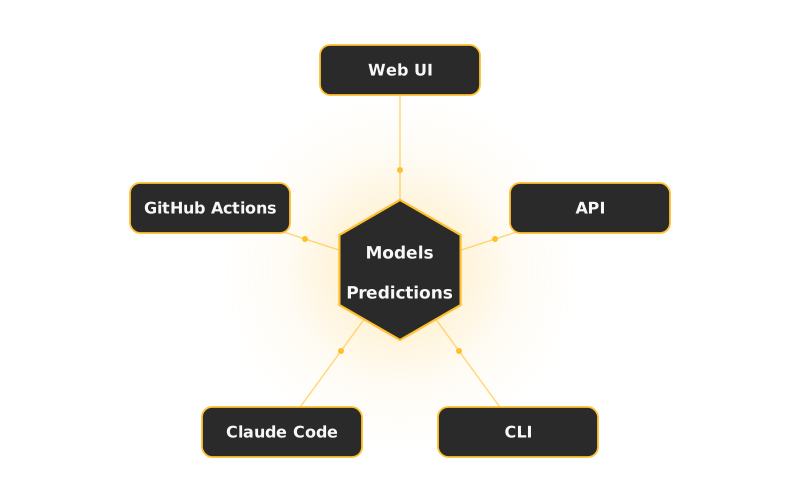
5 ways to drive it
One engine, five interaction surfaces. Pick the one that matches the task.
Web UI
Build connections, configure analyses and explore predictions in the browser — the fastest path for non-technical users.
API
A high-performance REST API for embedding predictions in customer-facing apps, back-office tools, or batch pipelines.
CLI
Script and automate everything from the shell with predictr-cli — ideal for ad-hoc work, scheduled jobs and reproducible setups.
Claude Code
Drive the platform conversationally from Claude Code via our plugin. Ask for an analysis, get one built, get the answer back.
GitHub Actions
Train, refresh and deploy models — and provision the cloud data infrastructure they sit on — straight from your CI/CD pipelines. See github.com/predictr-io.
Algorithms
Battle-tested models, applied automatically based on the question you're asking.
FPGrowth
Frequent-pattern mining to surface co-occurring items in baskets, invoices and event streams. The engine behind Market Basket Analysis.
K-Means clustering
Unsupervised grouping of customers (or any entity) by behavioural attributes derived from your transaction history.
Prophet
Time-series forecasting with seasonality and trend decomposition. Powers the forecasting analysis.
Decision trees & regression
Linear and logistic regression, ID3/C4.5 decision trees and related classical models — used inside the platform and exposed where they fit the task.
How a model gets built
1. Push work down
Filtering, joining and aggregation run inside your data store, not on a copy. Less data movement, faster builds, smaller bills.
2. Isolated build containers
Each model trains in its own dedicated container — your data never mixes with anyone else's, and runs are reproducible.
3. Tuned parameters
Hyperparameters are auto-tuned by heuristics on a sensible default path, but every knob is exposed if you want to override.
4. Served predictions
The fit object is persisted and exposed behind a low-latency API. Make predictions in the UI for inspection, or call them from your systems in real time.
Supported data stores
Connect directly to your data source — no copies, no extra hops.


